I finally got around to throwing together some of the clips I took as I was leaving Pemba and arriving in and touring around the coconunt plantation, village and beaches of Quirimba Island for the first time. You'll have to excuse the sometimes rough, shaky video in there, often because of the bumpy roads and/or my incompetence...and unfortunately due to some software bug that I can't figure out the first minute and a half is only sound, so you can either skip ahead or sit back and listen to one of the most famous songs to come out of Mozambique. In English it's called "Nightbird" and is by an artist called Wazimbo. The first time my TechnoServe friend Tricia played it for me, it really did give me the chills, and that haunting melody stayed in my head for days after. I guess I'm not the only one who liked it--the song was also featured in a movie directed by Sean Penn, The Pledge, and even in a Microsoft commercial. Anyway, this is clearly no Sean Penn movie or Microsoft commercial, but here you go:
Showing posts with label locals. Show all posts
Showing posts with label locals. Show all posts
Saturday, June 23, 2007

Wednesday, June 6, 2007
Meu Despedida do Maputo
...meaning 'my Maputo farewell.' Some pics of me enjoying my last days in Mozambique with some friends.


Here the crew I played soccer with on Sundays at Costa do Sol, the main beach in Maputo:


Below-left the TechnoServe Moz coconut team proudly displaying a tree seedling they had just brought back from the field. To the right Tricia (head of coconut team) joking with Sinezia our office receptionist and assistant.


And finally a few photos from my last night out. Appropriately enough we ate dinner at a middle eastern place and then headed to a Maputo mainstay, Africa Bar, which is exactly what I did on my first night out in Moz. From left to right...row 1: Tricia (Louisianian, full-time TechnoServe coconut/biofuels program director), Abe (our Somalian friend starting a business in Moz), Sam (South African TechnoServe volunteer consultant working on coconuts, Me, Anna (German TNS volcon also working on coconuts) ; row 2: Sam again, Fabio (Brazilian TNS volcon working on poultry), Magaya (local Maputo friend, who introduced me to the soccer gang and also works for his father's poultry business), Magaya again, and Arsenio (local Maputo friend currently studying at university):


As you can see, a pretty impressive mix of backgrounds--made for lots of good conversation and debate, often fueled by many Mozambican cervejas. Hope to be back in Moz soon to see some of these folks again and pick up where we left off...
Wednesday, May 30, 2007
Back in Maputo - chat with Jaime
The cool season is upon us--have been enjoying the mild weather back here in Maputo for the past week and a half. This morning, one of my last in the city, I was going to capture some video of the tree-lined streets and the nice sea views we get on the way to the office, but ended up spending most of the time chatting up Jaime, one of the TechnoServe drivers. A good thing, though, because Jaime's had a really fascinating life in Mozambique. This clip definitely doesn't do justice, but still I think some interesting bits to check out:
As you hopefully could make out, Jaime has seen a lot of change in his country. Originally from Xai Xai, in the Gaza province just north of Maputo...Jaime was a young man during colonial times, he fought in the Revolution, he lived through the years of civil war, and since he's found work in South Africa--and thankfully for TechnoServe--in Maputo as well where he's been now for 8 years. When I asked him if it's relatively stable in the country nowadays...you could tell he was thinking "well, yeah maybe to outsiders...but on the other hand there's still some tension under the surface and you never know when things could break down"...which I guess can appreciate better now having lived here a couple months. Still, it's fair to say Mozambique has made a lot of progress on political stability, especially when you compare to some of its neighbors like Zimbabwe where things are really pretty troubling right now.
As you hopefully could make out, Jaime has seen a lot of change in his country. Originally from Xai Xai, in the Gaza province just north of Maputo...Jaime was a young man during colonial times, he fought in the Revolution, he lived through the years of civil war, and since he's found work in South Africa--and thankfully for TechnoServe--in Maputo as well where he's been now for 8 years. When I asked him if it's relatively stable in the country nowadays...you could tell he was thinking "well, yeah maybe to outsiders...but on the other hand there's still some tension under the surface and you never know when things could break down"...which I guess can appreciate better now having lived here a couple months. Still, it's fair to say Mozambique has made a lot of progress on political stability, especially when you compare to some of its neighbors like Zimbabwe where things are really pretty troubling right now.
Thursday, May 24, 2007
Last day on Quirimba
And so my second and last visit to Quirimba--at least for this project--had to end, but I did get a chance to head back to the beach on the southeast end of the island. This is where I first ran into the two little kids who followed me around several weeks ago. Turns out their names are Manuele and Noventa and their father is a guard for my client's coconut plantation. Sure enough they were hanging around their straw ("macuti" in Moz) home cooking breakfast and playing on the beach when I showed up. They quickly ran over and I gave them a copy of those couple of pictures I had taken last time, which they got a real kick out of. It was fun--they certainly seemed happy, laughing and smiling at the time, but it does make it easy to forget the reality for families like this one in this island community and the neighboring ones where illiteracy is 83%, unemployment is 18% and the poverty index is 68% (compared to single digits or teens for most of the first world). Still, although I believe in Technoserve's private sector/business enterprise approach...it's good to once in a while get away from the Excel spreadsheets and business plans and remind yourself where you're hoping to eventually achieve impact with it all...


Finally, a few last images from Quirimba. Below-left the spot where I first met Manuele and Noventa, now at low tide covered with an almost luminescent green seaweed that we're actually hoping to be able to use as coconut tree fertilizer. Below-right the view out from my client's family house, and at the bottom a photo of me with the Gessners themselves.


Tuesday, May 22, 2007
Ibo II
...Ibo is also known for its arts and crafts. Below-left, an old man in the shadows sewing capulanas--Mozambican version of a sarong. Right, a silversmith selling jewelry made from old, melted down colonial silver coins:


Below, some photos of the Ibo Island Lodge, also a Technoserve client. They did a nice job retaining the feel of the island, while living up to the high standards of a 4/5 star type place:


And finally a Pimm's on the roof of the lodge with my client, Rainer, and his sister Carola while watching the sunset, and before realizing we had to set sail again to make it back to Quirimba before dark:


Sunday, May 6, 2007
Inhambane
Took a road trip a couple provinces to the north of Maputo to Inhambane. Partly on work--I checked out a couple lodges there, and my co-workers toured some coconut factories--but a good part of the time was spent in a really nice beach town called Tofo. Maybe the biggest backpacker destination in Mozambique.
Below-left the southern end of of Tofo's pristine beach. It was off this beach that I went on a little marine safari and got to swim over whale sharks, which are normally rare but were fairly plentiful in these waters. Seeing one is a major box to tick off for serious divers. Below-right, my co-workers and I with two of the managers at our hotel. The one in the middle, Helio, is also a somewhat well known music artist in Mozambique specializing in African/hip-hop fusioney kind of stuff, with a lot of looped vocal percussion. His website: http://crazyafrican.com/.


Below-left the southern end of of Tofo's pristine beach. It was off this beach that I went on a little marine safari and got to swim over whale sharks, which are normally rare but were fairly plentiful in these waters. Seeing one is a major box to tick off for serious divers. Below-right, my co-workers and I with two of the managers at our hotel. The one in the middle, Helio, is also a somewhat well known music artist in Mozambique specializing in African/hip-hop fusioney kind of stuff, with a lot of looped vocal percussion. His website: http://crazyafrican.com/.


On the way home from Inhambane, we stopped in another coastal town called Xai Xai where we stumbled upon some festivities celebrating Mozambique's Dia de Trabalhadores (Labor Day). To the left some of the dancers, to the right, me not blending in with the crowd:


Below also a rough clip of one of the dance routines. If you watch closely, the smallest kid who is initially to the left in the blue shorts and white headband was a riot. Biggest crowd pleaser by far:
Thursday, May 3, 2007
Maputo - around town
It's taken me a month to make a substantial post about Maputo, the capital of the country and where I'm more or less based in between my travels up north...but better late than never. As I mentioned early on, this city has both the tropi-colonial charm thing going as well as the delapidation and poverty you'd expect to see in a third world city. That said, my experiences so far here have been really positive. Relative to the rest of the country, Maputo could pass for a southeast African version of New York or San Francisco. Quite a bit of activity here be it commerce or culture. Some photos from the last full weekend I spent in the city below...
To the left, inside the old fortaleza--a shadow of a statue of some important Portuguese general I'm assuming. To the right, the entrance to the botanical park conspicously guarded by a statue of Samora Machel, the first president of independent Mozambique, and an adopter of Marxist policies. They were evidently pretty intent on drilling those ideals home, as some of the most prominent roads in Maputo are Avenidas Karl Marx, Vladimir Lenine and Mao Tse Tung:


Next up the mercado de peixe. A typical Sunday afternoon thing to do. First pick your catch and negotiate with the fishmongers as my co-worker Fabio is doing (left), and then head to one of the outdoor restaurants next door to have them cook it all up for you so you can eat it along with some cold cervejas (right). We went with fresh caught shrimp and lobster that day:


Finally, the beach along Maputo Bay. Left, some guys doing capoeira, which I hadn't realize had made it's way over here from Brazil. Right, more locals hanging out on the beach with the city skyline in the background:


To the left, inside the old fortaleza--a shadow of a statue of some important Portuguese general I'm assuming. To the right, the entrance to the botanical park conspicously guarded by a statue of Samora Machel, the first president of independent Mozambique, and an adopter of Marxist policies. They were evidently pretty intent on drilling those ideals home, as some of the most prominent roads in Maputo are Avenidas Karl Marx, Vladimir Lenine and Mao Tse Tung:


Next up the mercado de peixe. A typical Sunday afternoon thing to do. First pick your catch and negotiate with the fishmongers as my co-worker Fabio is doing (left), and then head to one of the outdoor restaurants next door to have them cook it all up for you so you can eat it along with some cold cervejas (right). We went with fresh caught shrimp and lobster that day:


Finally, the beach along Maputo Bay. Left, some guys doing capoeira, which I hadn't realize had made it's way over here from Brazil. Right, more locals hanging out on the beach with the city skyline in the background:


Tuesday, May 1, 2007
Quirimba - chat with Decima
Last Quirimba post for a while. This one a clip of me asking a few questions in my broken Portuguese to a local islander who was looking after the old lodge I was staying in.
Good to hear he's pro-tourism, since one of my main objectives is to put together the business plan to reopen a bigger and better eco-lodge.
Good to hear he's pro-tourism, since one of my main objectives is to put together the business plan to reopen a bigger and better eco-lodge.
Thursday, April 26, 2007
Quirimba - island life
In addition to the coconut plantation, Quirimba Island is unique to many of the other Quirimba archipelago islands around because of its village feel. There are about 4,000 people--a large proportion of them children--on the island. Most live off the local natural resources like fish and agro/horticultural products.
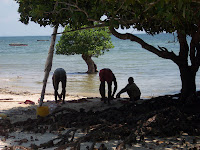
Below-left a few men cutting a up a ray they just caught. Unfortunately the islanders have fished their waters somewhat destructively over the years, using methods like putting poison in the water, using explosives even. As a result, the reefs and other marine habitats have been damaged. With the government declaring it national park land, however, hopefully the situation will improve. Below-right, a dugout fishing canoe, usually carved out of a single tree trunk:

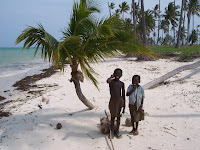
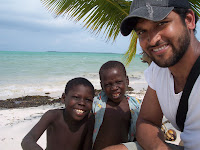
Like I said, there are a lot of children on the island. The population was only half what it was a decade or two ago, due largely to high birth rates as well as inreased immigration. Below are a couple brothers who were toting around some coconuts they had picked from (hopefully) one of their non-plantation palms, also called smallholder trees in the coconut biz. Unlike some of the adults who are sometimes a bit reserved or suspicious, just about every kid on the island is extremely curious and friendly. These two fellas wouldn't leave me alone once they spotted me on the beach, especially when they saw I had a camera:
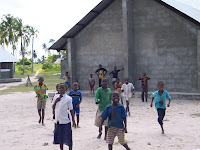
More islander children below-left, this time in front of a schoolhouse that had just been built and actually looked in pretty good shape. I was told, however, that the government or outside agency that built it spent 3 or 4 times the amount that it should have cost. Unfortunately, inefficiency is a recurring theme in this part of the world. Below-right is a picture of a maternity ward that was gifted to the island by an wealthy hotel operator from a neighboring island, but if you look closely they only built about 2 feet of the structure before running out of the money because the funds ended up getting diverted to other things:
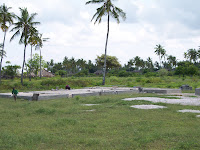
Below-left one of the many ruins left over from the Portuguese colonial days. This particular building I think was originally used for refrigeration--nowadays the locals just seem to kind of hang out in it for shade and gaze out the window at the water (look closely for kid gazing out window at water). Below-right, a group of woman hauling food from one part of the island to the other, by balancing it on their head...a common skill it seems of women in developing countries:


Below-left a few men cutting a up a ray they just caught. Unfortunately the islanders have fished their waters somewhat destructively over the years, using methods like putting poison in the water, using explosives even. As a result, the reefs and other marine habitats have been damaged. With the government declaring it national park land, however, hopefully the situation will improve. Below-right, a dugout fishing canoe, usually carved out of a single tree trunk:


Like I said, there are a lot of children on the island. The population was only half what it was a decade or two ago, due largely to high birth rates as well as inreased immigration. Below are a couple brothers who were toting around some coconuts they had picked from (hopefully) one of their non-plantation palms, also called smallholder trees in the coconut biz. Unlike some of the adults who are sometimes a bit reserved or suspicious, just about every kid on the island is extremely curious and friendly. These two fellas wouldn't leave me alone once they spotted me on the beach, especially when they saw I had a camera:


More islander children below-left, this time in front of a schoolhouse that had just been built and actually looked in pretty good shape. I was told, however, that the government or outside agency that built it spent 3 or 4 times the amount that it should have cost. Unfortunately, inefficiency is a recurring theme in this part of the world. Below-right is a picture of a maternity ward that was gifted to the island by an wealthy hotel operator from a neighboring island, but if you look closely they only built about 2 feet of the structure before running out of the money because the funds ended up getting diverted to other things:


Below-left one of the many ruins left over from the Portuguese colonial days. This particular building I think was originally used for refrigeration--nowadays the locals just seem to kind of hang out in it for shade and gaze out the window at the water (look closely for kid gazing out window at water). Below-right, a group of woman hauling food from one part of the island to the other, by balancing it on their head...a common skill it seems of women in developing countries:


Friday, April 20, 2007
Pemba II
I'm back in Maputo, and back to a relatively not-horrible internet connection. My first trip to Pemba and Quirimba Island was a good one--a beautiful part of the country that I got to see, but also was able to make a lot of progress on my project. Over the next week I'll post some of the photos and videos I took while there, starting with these looking out from my back porch onto Wimbi Beach in Pemba:


Subscribe to:
Posts (Atom)